Wednesday, November 30, 2011

IRS Seeks to Return $153 Million in Undelivered Checks to Taxpayers

Recommends e-file, Direct Deposit to Avoid Future Delivery Problems 

WASHINGTON — In an annual reminder to taxpayers, the Internal Revenue Service announced today that it is looking to return $153.3 million in undelivered tax refund checks. In all, 99,123 taxpayers are due refund checks this year that could not be delivered because of mailing address errors.
Undelivered refund checks average $1,547 this year.
Taxpayers who believe their refund check may have been returned to the IRS as undelivered should use the “Where’s My Refund?” tool on IRS.gov. The tool will provide the status of their refund and, in some cases, instructions on how to resolve delivery problems.
Taxpayers checking on a refund over the phone will receive instructions on how to update their addresses. Taxpayers can access a telephone version of “Where’s My Refund?” by calling 1-800-829-1954.
While only a small percentage of checks mailed out by the IRS are returned as undelivered, taxpayers can put an end to lost, stolen or undelivered checks by choosing direct deposit when they file either paper or electronic returns. Last year, more than 78.4 million taxpayers chose to receive their refund through direct deposit. Taxpayers can receive refunds directly into their bank account, split a tax refund into two or three financial accounts or even buy a savings bond.
The IRS also recommends that taxpayers file their tax returns electronically, because e-file eliminates the risk of lost paper returns. E-file also reduces errors on tax returns and speeds up refunds. Nearly 8 out of 10 taxpayers chose e-file last year. E-file combined with direct deposit is the best option for taxpayers to avoid refund problems; it’s easy, fast and safe.
The public should be aware that the IRS does not contact taxpayers by e-mail to alert them of pending refunds and does not ask for personal or financial information through email.  Such messages are common phishing scams.  The agency urges taxpayers receiving such messages not to release any personal information, reply, open any attachments or click on any links to avoid malicious code that can infect their computers.  The best way for an individual to verify if she or he has a pending refund is going directly to IRS.gov and using the “Where’s My Refund?” tool. 

Thursday, November 17, 2011

I GOT A 1099-A NOW WHAT?


When a house is foreclosed upon by the bank, the owners typically receive Form 1099-A from the lender showing several pieces of relevant information. The information on Form 1099-A will likely be needed to report the foreclosure on your tax return. A foreclosure is treated as the sale of property, and the former property owner will need to calculate their gain or loss on the property. But unlike a normal sale, there's no "selling price," and this is where the Form 1099-A comes into play. 
Taxpayers will need to report the foreclosure just like it were a sale of the property. And to properly report this, you'll need to know the selling date and selling price of the property. Form 1099-A provides you with the date of sale and the "selling price" of the property, which is half the information you need to report the sale of the foreclosed property on your tax return. The other half of the information you need is the purchase date and purchase price; and that information will be found in your escrow statements from when the property was purchased.
Figuring out the "selling price" of the property is a bit complicated. The answer depends on the type of loan. Taxpayers will utilize either the fair market value of the property or the outstanding loan balance on the property for the selling price. Both of these figures are reported on Form 1099-A. The outstanding loan balance is found in Box 2; the property's fair market value is found in Box 4. The date of the foreclosure is indicated in Box 1, and this will be used as the date the property was disposed of (that is, the "sale date"). Taxpayers will also need to know if the loan was a recourse or a non-recourse loan; the loan was a recourse loan if the bank has checked Box 5 which states "If checked, the borrower was personally liable for repayment of the debt?"
People might receive multiple Forms 1099-A (one from each lender) for a single property. People might also receive Form 1099-C instead of Form 1099-A if the lender both foreclosed on the property and canceled any mortgage debt for which the borrower was personally liable.
Gain or loss is reported on Schedule D for homes that were personal residences. As a reminder, the IRS does not allow people to claim a loss on personal residences. Any gain (and I have seen situations where a foreclosure results in gain being reported) on personal residences can be offset by the capital gains exclusion for a main home.
So what do you do with Form 1099-A, exactly? First, if the foreclosed property was your personal residence, the foreclosure will be reported on Schedule D. You'll use the date of the foreclosure (found in box 1 of the 1099-A) as your date of sale. You'll need to indicate the selling price. This will be either the amount in box 2 or the amount in box 4. Which figure you'll use depends if you are liable to repay the loan, recourse loan. If box 5 is checked on the 1099-A, the sale price is the lesser of box 2 or box 5. If box 5 is not checked, the sale price is box 2.  You'll also need to indicate your purchase price or cost basis in the property. That information you should have in your records, usually from the HUD-1 closing statement from when you purchased the property. The difference between the selling price and your cost basis will result in your gain or loss. Gains are taxable, losses personal residences are not tax-deductible.
If the property was  a rental, you'll report the same information as above, but you'll use Form 4797. I advise people who have foreclosed rental properties to seek assistance as there are additional factors to take into consideration, such as recapture of depreciation deductions, passive activity loss carryovers, and reporting any final rental income and expenses.

 IRS CIRCULAR 230 Disclosure:
Under U.S. Treasury Department regulations, we are required to inform you that, unless expressly indicated, any tax advice contained in this post, or any attachment hereto, is not intended or written, to be used, and may not be used to (a)avoid penalties imposed under the Internal Revenue Code (or applicable state or local tax law provisions) or (b)promote, market, or recommend to another party any tax-related matters addressed herein.


Tuesday, November 15, 2011

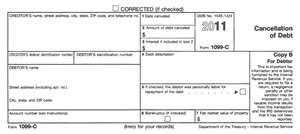
I GOT A 1099-C NOW WHAT?


The IRS form 1099 is used by various entities to report income that they have perceived you have earned. Example: Big Bank issues you a credit card. You run up $2,000 and never pay. After some time Big Bank will issue a 1099 to you. They are also reporting the $2000 as income you have earned, to the IRS. A 1099 can be a blessing because no one else can come after you for the $2,000, the bad side is that now you may have to pay income tax on the $2000.
The IRS requires financial institutions to report to them the amount of principal they charge-off for individual borrowers. It is only to be filed after you have stopped collection activity and there has been no payment activity on the account for three years. This is not a way for financial institutions to try and collect further. It is an added burden on them to track these conditions and find the records when they meet the criteria for filling. The financial institution had written the debt off years earlier.
 
More information for consumers
If you're receiving one of these, the most common reason is consumer debt, credit cards--banks may also issue 1099-c forms for mortgages,
1.) You have a debt that was never paid, or partially paid, sold to a collection agency who still couldn't collect, etc. Whatever the point is, whoever owns the debt is writing it off as a loss. This is not very common because unless you file for bankruptcy, most collection agencies or banks won't simply "give up" on you. If anything, they'll file for a judgment against you for the debt, interest, collection costs, capitalization fees, etc. It is very unlikely that you're receiving a 1099-C simply because the bank said "ah, lets write this one off." With the problems lenders are having these days, no bank is going to surrender debt as a loss. or,
2.) You had a collection agency or bank hounding you for money. Hopefully you were smart enough to pay them off with a lump sum instead of making payments that merely cover the interest. Anyway, if you were even smarter, you realized that the principal of the original debt (say it was a $5,000 credit card) was like 33% of the amount they were now demanding, and you cut a "deal" to close the case. Well, say it was a $5,000 credit card, they were demanding $13,500, and you gave them $10,000 to call it even. Well, the difference between the "demand" and your "settlement" is considered taxable income by the government. You have to pay income taxes on that $3,500 that you "gained."
Please note--some exceptions do apply. Most commonly, if you were insolvent at the time of the settlement (not bankrupt, insolvent) meaning your current liabilities (loans, debts, bills, etc.) outweighed your assets (income, savings/checking accounts, other assets like house, car etc.) you do not have to pay the tax---the theory being that the debt was written off because you couldn't pay. You must file Form 982 and complete an insolvency worksheet. Be prepared to prove that you are in fact insolvent.
IRS may ask for it. 


IRS CIRCULAR 230 Disclosure:
Under U.S. Treasury Department regulations, we are required to inform you that, unless expressly indicated, any tax advice contained in this email, or any attachment hereto, is not intended or written, to be used, and may not be used to (a)avoid penalties imposed under the Internal Revenue Code (or applicable state or local tax law provisions) or (b)promote, market, or recommend to another party any tax-related matters addressed herein.


Four Facts About Bartering

In today’s economy, small business owners sometimes look to the oldest form of commerce – the exchange of goods and services, or bartering. The fair market value of property or services received through barter is taxable income.

Bartering is the trading of one product or service for another. Usually there is no exchange of cash. However, the fair market value of the goods and services exchanged must be reported as income by both parties.

Here are four facts about bartering that small business owners should be aware of:


1. Barter Exchange A barter exchange functions primarily as the organizer of a marketplace where members buy and sell products and services among themselves. Whether this activity operates out of a physical office or is internet based, a barter exchange is generally required to issue Form 1099-B, Proceeds from Broker and Barter Exchange Transactions, annually to their clients or members and to the IRS.

2. Barter Income Barter dollars or trade dollars are identical to real dollars for tax reporting. If you conduct any direct barter - barter for another’s products or services - you will have to report the fair market value of the products or services you received on your tax return.

3. Taxes Income from bartering is taxable in the year it is performed. Bartering may result in liabilities for income tax, self-employment tax, employment tax, or excise tax. Your barter activities may result in ordinary business income, capital gains or capital losses, or you may have a nondeductible personal loss.

4. Reporting The rules for reporting barter transactions may vary depending on which form of bartering takes place. Generally, you report this type of business income on Form 1040, Schedule C Profit or Loss from Business, or other business returns such as Form 1065 for Partnerships, Form 1120 for Corporations, or Form 1120-S for Small Business Corporations.

 IRS CIRCULAR 230 Disclosure:
Under U.S. Treasury Department regulations, we are required to inform you that, unless expressly indicated, any tax advice contained in this post, or any attachment hereto, is not intended or written, to be used, and may not be used to (a)avoid penalties imposed under the Internal Revenue Code (or applicable state or local tax law provisions) or (b)promote, market, or recommend to another party any tax-related matters addressed herein.

Friday, November 11, 2011

Thursday, November 10, 2011

Tax Benefits Expiring in 2011 & 2012

It's almost the holiday season. Thanksgiving, then Christmas and finally the New Year.  With a New Year we will be getting tax law changes. Unless Congress extends these benefits, they are known to do that, look for your tax bill to go up in 2012 and 2013. 

Major Individual Income Tax Benefits Expiring 12/31/2011:
• Personal tax credits applied against income tax no longer apply
• Higher alternative minimum tax exemptions revert back to extraordinarily-low thresholds
• $250 school teacher expense deduction ends
• Mortgage insurance premium deduction expires
• State and local sales tax deductions expire
• Tuition and related fees deduction end
• IRA to charity tax-free transfers stop
• 2% Social Security tax reduction ends
Major Individual Income Tax Benefits Expiring 12/31/2012:
• Marriage penalty equalization ends
• Dividends taxed at capital gains rates removed, taxed at regular rates now
• Capital gains low tax rates expires
• Removal of itemized deduction phase out for higher income Americans
• Removal of personal exemption phase out for higher income Americans
• Child care deduction limit of $3,000 reverts to $2,400
• Child credit reduces from $1,000 per child to $500 per child
• Low 10% tax bracket for low income Americans is eliminated
• Lower income tax rates and smaller brackets expires
• Refundable adoption credit and reduced deduction
• American Opportunity college education credit expires
• Major reduction in earned income credits and refunds
• Income tax exemption for debt forgiven on home foreclosures and repossessions
• Deduction for student loan interest ends
• Education IRA limit drops from $2,000 to $500

Here's How to Tell the Deals From the Duds at a Dollar Store

Despite their name, 99-cent stores can offer great deals on items like coloring books, notepads, stocking stuffers, baby clothes, soap, and so on.
"The biggest misconception about dollar stores is that they only have junk that no one needs and everything is low quality," says Andrew Schrage of MoneyCrashers, an investment website.
There's too much competition for them not to offer similar products to general stores.
But watch out: Some products should only be bought at a general store. Read through to see if you can guess what's a deal and a dud at the 99-cent store.
DEAL: Pet Toys
Pet toys can stand to get beaten (and eaten) up since they're so cheap, and the store usually has a great selection.
NO DEAL: Batteries and Other Electronics
Some stores sell "gray goods," or products made for a foreign market. Oftentimes they fail to comply with U.S. regulations and as a result, they can be dangerous.
Batteries can be prone to leakage and fail to last as long as name-brand batteries. This means you'll spend more on replacements.
Also be forewarned that some UL labels on electronics and extension cords may say they're U.S. approved when they aren't.
NO DEAL: Domestic Fire Products
Lighters, tiki torches, barbecue makers, and outdoor candles should never be bought from a dollar store. If you do, you might find your house go up in flames like a Hawaiian-themed barbecue.
DEAL: Cookware
Dollar stores stock lots of basic cooking supplies, including pots, pans, spatulas, ice cream scoopers, cheese graters and oven mitts.
You'll save 50 to 90 percent on items, compared to prices at Target, but sometimes these kits will be really dirty, missing pieces, or just flat-out broken. Check to make sure.
NO DEAL: Groceries
Whatever amount you might save isn't worth the risk of eating counterfeit products or food made for international destinations that haven't been U.S. approved.
The merchandise may be also expired: Food-carrying containers sit outside for long periods of time, and temperature changes spoils the food, Terri Gault, founder of TheGroceryGame.com, tells MainStreet.
In terms of pricing, grocery stores offer better deals, especially with pre-packaged baking goods and generics. The big box stores are even cheaper when they're having a sale or giving out coupons.
DEAL: Cleaning Supplies
Buy these, especially items like mops, rubber gloves, or sponges. They're the same as what you'd get at the grocery store, just cheaper.
You can also go for liquid cleaners, says Schrage, but oftentimes their formula is diluted and leaves residue.
Also think about buying disposable clean-up items like toilet paper and paper towels. Keep in mind, however, that you may want to buy these toiletries in bulk.
DEAL: Greeting Cards
Dollar stores stock up on lots of good, quality cards, which they sell for cheap. A drugstore like Duane Reade will charge $1.40, but the 99-cent store price comes in at about 50 cents.
DEAL: Party Supplies
As with greeting cards, dollar stores always restock party supplies.
Their merchandise tends to be fun and lively, and most importantly, cheap. They carry everything you need, from hats to plastic plates, cups, and utensils.
NO DEAL: Children's Toys
DO NOT buy these at a 99 cents store. 99-cent store toys are made cheaply so you won't want to risk having a piece breaking off in your kid's throat. Same goes for baby products—avoid them.
Items sold in the dollar stores sometimes bypass U.S. approval, which as we pointed out earlier, could mean high levels of lead and other chemicals. Remember those Chinese Mattel dolls?
NO DEAL: Over-the-Counter Medications
Stay away from vitamins, as the amount of nutrients the label claims is probably faulty. Cheap vitamins also don't dissolve quickly enough for your body to absorb them.
Similarly avoid buying aspirin, ibuprofen, and other over-the-counter meds at a 99 cent store. Independently-owned 99-cent stores have been known to counterfeit these products.
"Suppliers digitally alter a label and scan it into a generic bottle or package," Greg Guila, a lawyer specializing in patent law at the firm Duane Morris, tells MainStreet.
 
 This article is part of a series related to being Financially Fit.